The Recipe Is Not a Stopwatch
Learn to read cooking cues instead of trusting the timer alone, so you can judge when vegetables, grains and sauces are ready by texture and appearance.
The common mistake with cooking times is treating the number in a recipe as proof that food is ready. The recipe is not a stopwatch: a timer can remind you to look, but following it blindly can leave vegetables limp, grains chalky or a sauce thinner than you wanted.
Use the stated time as a window, then judge the food itself. Look for changes in shape, colour and surface; use a spoon, fork or small tasting spoon to check texture. This is not guesswork. It is a repeatable kitchen habit: observe, check, decide, then give the food more time only if it needs it.
Start with the cue
Before cooking, read the recipe for more than its minutes. Notice the words that describe the intended result: tender, translucent, thickened, browned or just wilted. Those are cues to look for. If a recipe gives no useful description, decide what texture you want before you begin.
Consider the ingredients and their starting state. A carrot cut into thick batons will soften differently from one cut into fine slices. Chilled food may take longer to heat through than food already at room temperature. A crowded pan can trap steam, while a broad pan lets moisture escape. These details help explain why a time is an estimate rather than a verdict.
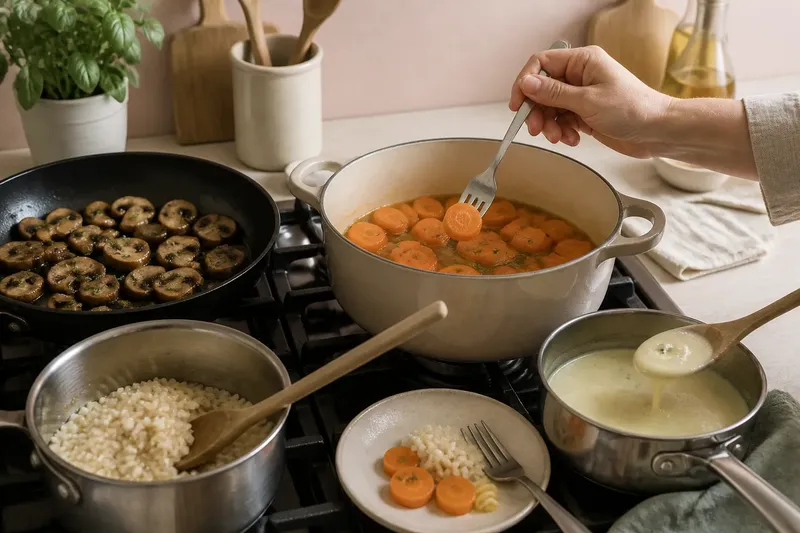
Set out a small plate or tasting spoon before you start. Keep a fork for checking vegetables and a wooden spoon for stirring sauces. That way, checking the food is a deliberate part of cooking, not a frantic search for a tool while something sits over the heat.
Watch the first changes
As ingredients heat, their appearance begins to tell you what is happening. Onions may shift from opaque and firm to soft and translucent. A pan of mushrooms may first look crowded and wet, then shrink as liquid cooks away. Neither change follows an exact schedule; both tell you what to watch next.
Look at the whole surface, not just one piece at the edge. Heat can be uneven, especially in a crowded pan. Stir or turn the food when needed, then pause long enough to see whether the next change is happening. Constant stirring can hide browning; leaving food untouched for too long can let it catch.
For vegetables, compare colour and shape with the result you want. Bright green broccoli that still holds its florets may suit a quick sauté, while a softer texture may be better for a soup. If the edges are darkening before the centre softens, lower the heat and add a little liquid if the dish allows.
When colour changes, ask what it means for this dish rather than assuming it means “done”.
Check texture directly
Use a fork or the tip of a small knife to test a piece from the centre of the pan. For vegetables, the utensil should meet the resistance that suits the meal: a crisp bite for a salad or a softer one for a stew. For pasta, taste a strand; it should have the texture you want throughout, without a hard, dry centre.
For grains, check a spoonful rather than relying on the liquid level alone. Rice or barley may look ready while the centre remains firm. If it does, cover the pan and continue cooking gently, adding a little hot water or stock if the pan is dry and the grain still needs to soften. Taste again after it has had time to absorb the liquid.
For a sauce, draw the back of a spoon through it. If the line stays briefly before filling in, the sauce has thickened; if it immediately runs together, it is still loose. The right consistency depends on what it must coat. A sauce for pasta can be fluid enough to cling after tossing, while a spooned dressing needs a different body.
Say you are cooking sliced carrots for a weeknight stew and the recipe’s suggested time has passed, but a fork still meets a firm centre. You keep the pot at a gentle simmer, cover it, and check again after a short interval. The expected cue is a fork that slips in with light resistance, not a particular number on the clock.
Read browning and moisture
Colour and moisture matter together. A pale, wet surface usually means ingredients are steaming rather than browning. If browning is the goal, avoid piling too much into the pan; work in batches if necessary and let the exposed surfaces make contact with the hot pan.
Watch for the change from wet bubbling to quieter sizzling, but do not wait for every last trace of moisture to vanish. Food can move quickly from browned to scorched. Stir or turn pieces when their undersides have developed the colour you want, and reduce the heat if dark spots appear before the rest is ready.
For a soup or braise, liquid should move at a gentle simmer rather than a violent boil. Small bubbles and soft movement suggest restrained heat. If the liquid is splashing hard, lower the heat; a rolling boil can break delicate ingredients apart without making them taste more developed.
What should you check?
How do you tell when onions are soft?
Press a piece with the back of a spoon or taste a cooled sliver. Soft onions bend easily and have lost their raw, sharp bite; if they still feel crisp, continue cooking gently.
How can you tell when pasta is ready?
Taste a strand rather than judging its surface. Stop when the centre has the firmness you prefer, allowing for any further cooking if the pasta will be finished in hot sauce.
What does a thickened sauce look like?
A sauce that clings to the back of a spoon is thicker than one that runs off at once. Check it off the heat briefly, since a hot sauce can appear looser than it will after a short rest.
Should food always match the recipe’s colour?
Use the recipe’s description as a guide, then consider your pan, heat and ingredients. Colour is useful evidence, but pair it with a texture check, especially when the centre matters.
Adjust without losing control
When the cue is not there yet, make one modest change at a time. Lower the heat if the outside is darkening too quickly; add a splash of liquid if a grain or braise is drying before it softens; uncover a wet pan when you want liquid to evaporate. Then give the food a chance to respond before changing anything else.
Keep track of what you changed. If you lower the heat and cover the pot, check for tenderness rather than expecting the surface to brown. If you uncover a sauce to reduce it, watch its thickness and stir so the base does not catch. A single adjustment makes the next cue easier to interpret.
Do not repeatedly pierce delicate vegetables or stir a sauce just to feel busy. One careful check is usually more useful than several hurried ones. Let the food continue cooking between checks, particularly when you are waiting for a grain to soften or a braise to become tender.
Know when time still matters
Time remains useful for planning and for food-safety guidance, but it cannot replace all other checks. For meat, fish, eggs and other foods where safe doneness matters, follow reliable food-safety guidance and use an appropriate food thermometer when called for. Appearance alone cannot confirm safety. If the correct method depends on a product label, manufacturer instructions or local rules, follow those directions.
For ordinary texture decisions, use the timer as a prompt to inspect. A recipe’s range can help you decide when to begin checking; a visible or tactile cue helps you decide what to do next. If the dish needs more time, continue in small intervals and test the part most likely to lag behind.
Keep a short note beside a recipe when your kitchen consistently behaves differently: record the pan you used, the cut of the vegetables and the cue that told you they were ready. Next time, use that observation to start checking sooner or later, while still letting the food—not the clock—make the final call.