The Long Journey of the Table Fork
The table fork became ordinary through changing dining customs, not a single invention. Trace its path and see why this small utensil reshaped shared meals.
The common mistake in telling the table fork’s history is to look for one inventor or one decisive arrival. That costs us the more useful explanation: how different communities made an unfamiliar utensil part of ordinary dining. The table fork’s history is a story of changing customs, not a straight march from invention to universal acceptance.
Early fork examples
Historical examples show why it is difficult to name one origin for the table fork. In ancient Greece, small fork-like implements were used for serving food, rather than as the personal eating forks familiar at many tables today. In the Byzantine court, forks were associated with elite dining; accounts of their use there helped shape later European stories about the utensil. These examples point to distinct settings and purposes, not a single moment when everyone began eating with a fork.
European adoption also varied. Forks appeared at some Italian tables before they became familiar in other parts of Europe. Their use spread unevenly through elite households and formal dining, while many people continued to eat with their hands, spoons or knives. Knowing about a fork did not mean owning one, or using one at every meal.
The useful distinction is between a tool’s presence and its place in daily life.
Why the fork seemed odd
People can eat many foods with their hands, a spoon or a knife. A fork therefore answered no universal need. In many meals, diners reached for food directly, used bread to lift or wipe it, and relied on a knife to divide portions. The fork’s prongs could look unnecessary beside these familiar methods.
Its shape also invited suspicion. A small implement with points might seem too delicate for ordinary work, or awkward beside a sturdy knife. A change in table practice asks people to learn a new movement and accept a new object in a setting already governed by custom. That is a social hurdle as much as a practical one.
When a utensil does not solve an obvious problem, its acceptance depends on the meals and manners around it.
How customs travelled
Forks circulated through contact between communities, travel and elite households, but their presence did not instantly change everyday dining. A utensil might be seen at a formal table long before it became common in kitchens or ordinary homes. Some diners used it for particular foods; others continued to eat as they had learned.
That uneven movement is why a single origin story misleads. Forks took different forms and served different purposes in different places. One community could know of them without adopting them as a standard personal utensil. Elsewhere, a fork could gain status at court while remaining unfamiliar to most households.
Trade and travel carried objects, but social approval shaped whether people wanted to use them.
What changed at table
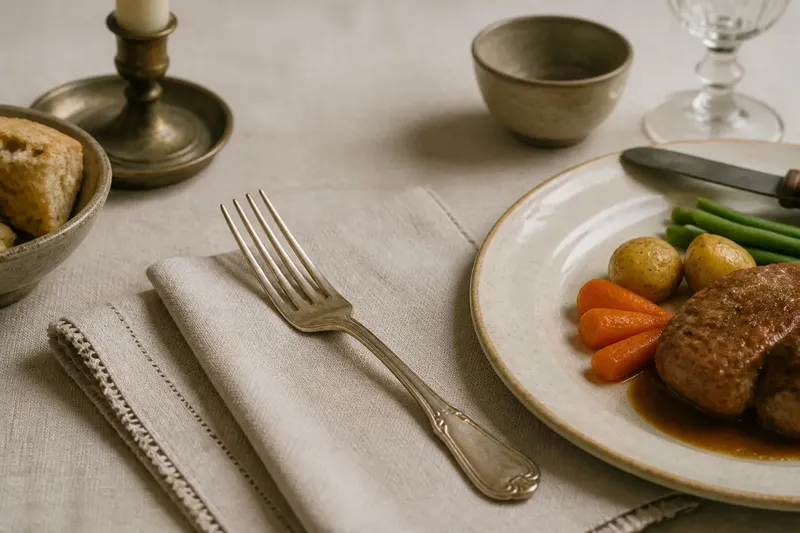
One important shift was from treating the fork as a serving tool or specialised implement to keeping one beside each diner. That altered the table setting. The utensil no longer belonged only to the person carving or passing food; it became part of each person’s place.
As courses and serving practices changed, diners encountered foods that were easier to hold with a fork. It could steady a piece while a knife cut it, lift morsels from a dish, or keep fingers away from sauces. These uses made it useful without making it indispensable. The meal itself helped teach the hand what to do.
Etiquette also gave the fork a public meaning. Handling food with an implement could signal restraint, polish or membership in a particular social world. Those signals changed over time. Once associated with formal dining, the fork could later feel like plain good manners.
A place setting teaches diners how the meal is expected to proceed.
Why acceptance varied
Household routines rarely change all at once. A family could own forks for guests yet use other methods at everyday meals. A host might set them out for a formal dinner, while workers or children ate with utensils they already knew. Availability, local custom and the food being served all affected the pace of change.
Nor did all regions move in the same direction at the same speed. Eating conventions differ with cuisine and with the structure of a meal. In some settings, chopsticks, spoons or hands remain the natural choice for particular dishes. The fork’s spread should not be mistaken for a universal replacement of other practices.
Say a household has recently acquired table forks but serves stews and bread at most meals. The forks stay in a drawer until a guest brings a dish that is easier to lift with prongs. The host then sets them out for everyone, and diners imitate the movement they see; the observable change is that forks appear at similar meals, not that every custom changes at once.
Questions about forks?
Did one person invent the table fork?
No single inventor explains the fork’s place at the everyday table. Fork-like implements and dining practices developed in varied settings, while broad acceptance depended on later social and household choices.
Why did some diners resist it?
A fork could seem unnecessary, awkward or too closely tied to unfamiliar manners. Resistance often reflected comfort with established ways of eating rather than a dispute over how the utensil worked.
When did it become ordinary?
There was no single moment when every household adopted it. Its everyday status emerged unevenly as domestic habits, formal dining and expectations of personal place settings changed.
Did the fork replace the knife?
No. The knife continued to cut and portion food, while the fork often steadied or lifted it. At many tables, the two became a working pair rather than competing tools.
Reading the table setting
The fork’s history is easiest to see in the small choices people repeat. A host placing a fork at each setting assumes each diner will use one. A child learning to steady food with its prongs absorbs the practice as ordinary. A restaurant offering forks alongside other utensils recognises that diners may expect different tools for different dishes.
These routines make customs feel natural, though they were learned. Cutlery placement, serving style and table etiquette can shift without anyone announcing a turning point. The fork did not simply win an argument about efficiency; it became familiar because social settings gave it a role and households repeated the gesture.
That explains why the table fork’s long journey is a story of changing customs rather than a race to identify a first. The object mattered, but so did who used it, when it appeared and what its use seemed to say. Its path from less familiar implement to everyday utensil followed many small acts of imitation and accommodation.
At your next meal, notice which foods invite a fork and which do not. That ordinary choice is a reminder that table manners are practical habits, shaped by the food in front of you and by the people sharing it.